The part nobody publishes
What makes a file printable
Almost every printing problem was already in the file. Here are the numbers, so you can check your own before you send it — and if you would rather we did, that is free.
“It looks fine on your phone. At one metre wide, every problem gets bigger too.”
The number that decides most of it
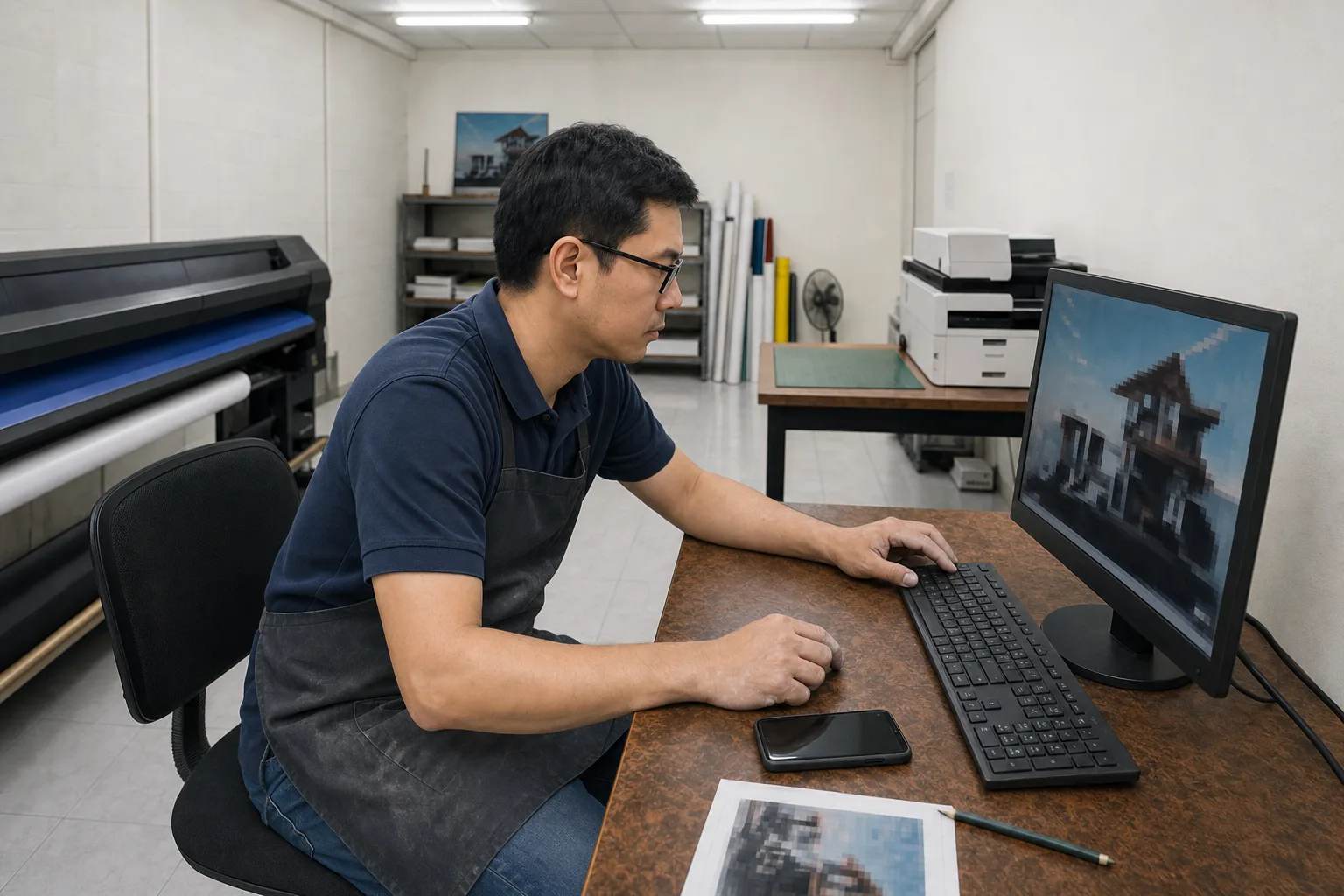
Resolution, at the size it will actually be printed
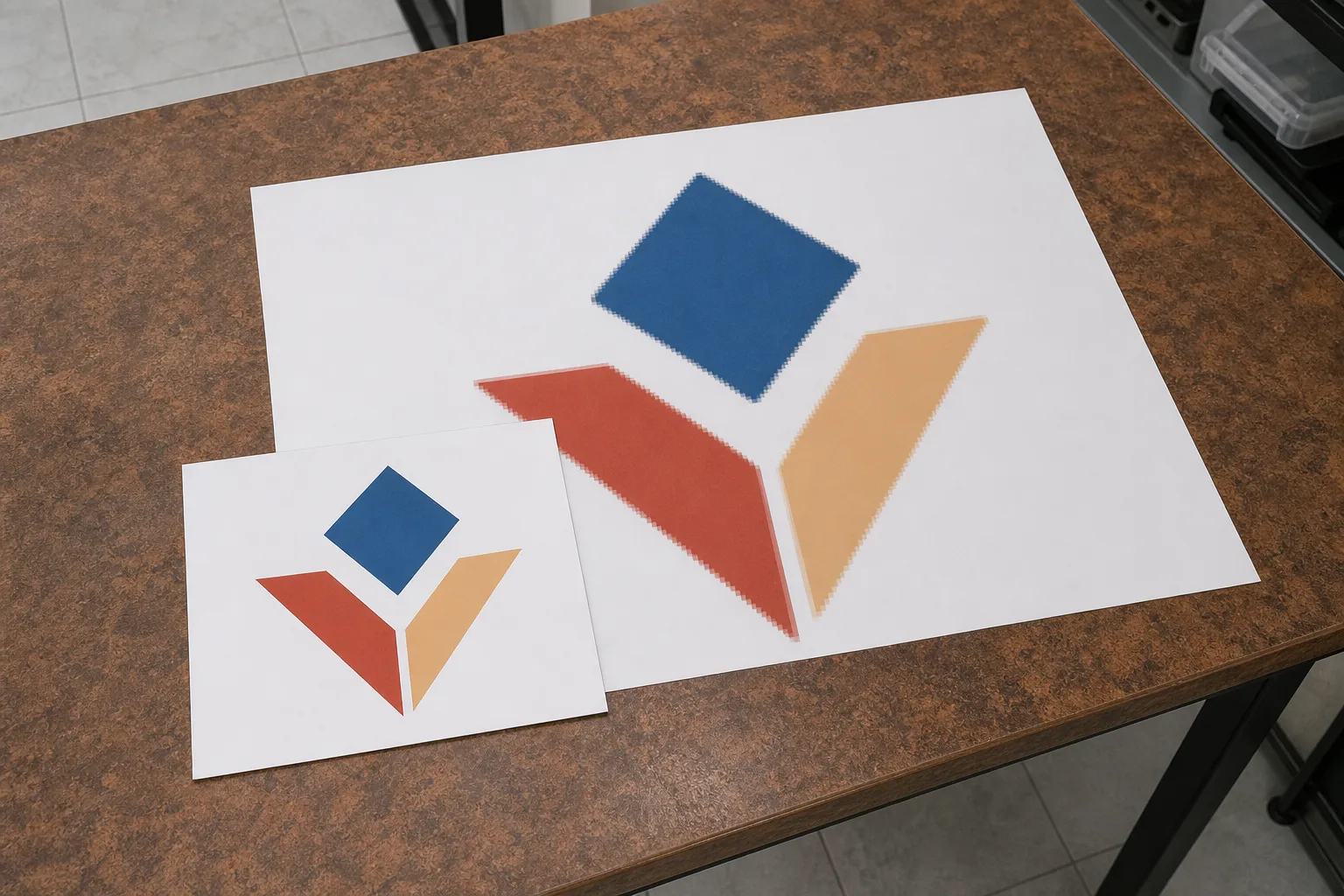
Press work needs 300 dpi at finished size. A banner needs about 100, because nobody stands closer than two metres to one. So the same file can be perfect on a card and hopeless at a metre wide.
| What you probably have | Pixels wide | Biggest on a card or menu | Biggest on a banner |
|---|---|---|---|
| A logo screenshotted off a phone | ≈ 400 | 3.4 cm | 10 cm |
| An image saved from Facebook or LINE | ≈ 800 | 6.8 cm | 20 cm |
| A decent web image | 1,500 | 12.7 cm | 38 cm |
| A good stock photo | 3,000 | 25 cm | 76 cm |
| A photo from your phone | ≈ 4,000 | 34 cm | 1.0 m |
The last row is deliberate, and it is good news: a photo taken on your own phone is usually big enough. The thing that is almost never big enough is a picture saved off social media — those are re-compressed down to about 800 pixels, which is fine on a card and about 20 cm on a banner.
The other number people guess at
How small type can go
| Where | Minimum |
|---|---|
| Press work | 6 pt |
| Laminated menus and cards | 7 pt — lamination softens fine edges |
| Reversed out of a dark colour | 8 pt, and never a hairline serif |
| Banners | Cap height ≈ 25 mm for every metre of viewing distance |
That last line is why A banner isn’t a menu. The person walking past has about three seconds. Read from ten metres away, the capital letters need to be about 250 mm tall — which is most of a metre-tall banner, and leaves room for roughly five words.
What gets cut off
Bleed and safe margins
| Bleed | Keep text inside | |
|---|---|---|
| Press work | 3 mm all round | 5 mm from the trim |
| Vinyl banners | 30 mm all round | 60 mm — the hem and eyelets live there |
| Roll-up stands | 30 mm top | 100 mm at the bottom disappears into the cassette |
What moves in conversion
Colour
Everything prints in CMYK. RGB files are converted, and some colours do not survive the trip. We name them rather than let you discover them.
Bright RGB green, electric blue and neon orange-red have no CMYK equivalent
They print noticeably duller. If one of them is your brand colour, tell us and we will get as close as the inks allow — before the run, not after.
Large black areas need rich black: C40 M30 Y30 K100
Black on its own (K100) prints as a washed grey-brown over any large fill.
Registration black is for registration marks only
All four plates at 100%. Never set text in it — at small sizes it will not hold register and the letters fringe.
Total ink limit 300%
Above that the sheet does not dry properly and offsets onto the one above it in the stack.
The invisible break
Fonts, and Thai in particular
Outline the type, or send us the font file. If a font substitutes, the layout moves — and you will not always be able to see that it has.
Thai breaks first and most visibly. Tone marks and vowels sit above and below the consonant, and a substituted font repositions them. The text is still readable to a machine and obviously wrong to any Thai reader. It is the single most common fault in files that came from a designer who does not read Thai, and it is point five of the free check for exactly that reason.
The shop’s own name
ร้านแบงค์ พริ้นท์
Four marks above the line, one below. Substitute the font and they scatter — the kind of thing a spell-checker will never catch and a customer will spot instantly.
What to send
Formats we accept
Preferred
Press-ready PDF, fonts embedded or outlined, 3 mm bleed
Fine
AI, PSD, high-resolution PNG or JPG, Canva “PDF Print” export
Accepted, but it will be rebuilt
Word, Excel, PowerPoint, Publisher. Rebuilding is chargeable.
Not accepted as final
A screenshot · an image saved from Facebook, LINE or Instagram · a photo of a printed page · a logo with a white box behind it, on a coloured background
Files up to 200 MB by LINE or email; anything larger, send a Drive link. Canva is on the “fine” list deliberately — it is what this market actually uses, and a print shop that sneers at it is being unhelpful rather than professional. The export setting is the only thing that matters, and we will tell you which one.
Free, whether or not you order
The eight points
- 01
Actual resolution at your finished size
Not the file’s pixel count — what it works out to at the size you asked for.
- 02
Bleed and safe margin
Whether they are there, and what will be cut off if they are not.
- 03
Colour mode, and which colours will move
RGB files are converted. Some colours cannot survive it, and we name them rather than let you find out.
- 04
Fonts
Embedded, outlined, or about to be substituted with something else.
- 05
Thai tone marks and vowel positions
These break first and most visibly when a font substitutes, and they are the thing a non-Thai designer never checks.
- 06
Anything under 6 pt
It will not read. On a laminated menu, under 7 pt.
- 07
Whether the file size matches the size you ordered
An A4 file scaled to A3 loses a quarter of its resolution, and nobody notices until it is printed.
- 08
Whether the stock suits where the thing will live
Indoor, outdoor, handled daily, written on, near water.
If the mistake is ours, we reprint it free. If it is in a file you approved, it is a new order. That is why we check first, and that is why the check costs nothing.
Send a file for checking